O2C Value Chain View
1. Order-to-Cash (O2C) Definition
Order-to-Cash (O2C) is the end-to-end business process encompassing everything from receiving a customer's order to collecting payment. It is the revenue-generating engine of the company — every delay or error in this chain directly impacts cash flow and customer satisfaction.
2. How O2C Connects to the Wider Business
O2C does not exist in isolation. It relies on the broader Supply Chain (to ensure semi-finished and raw materials are available) and links directly to Finance (to recognize revenue and manage cash flow). The O2C value stream is the critical segment where the company's internal efforts are finally monetized.
3. Order-to-Cash Value Stream Map (VSM)
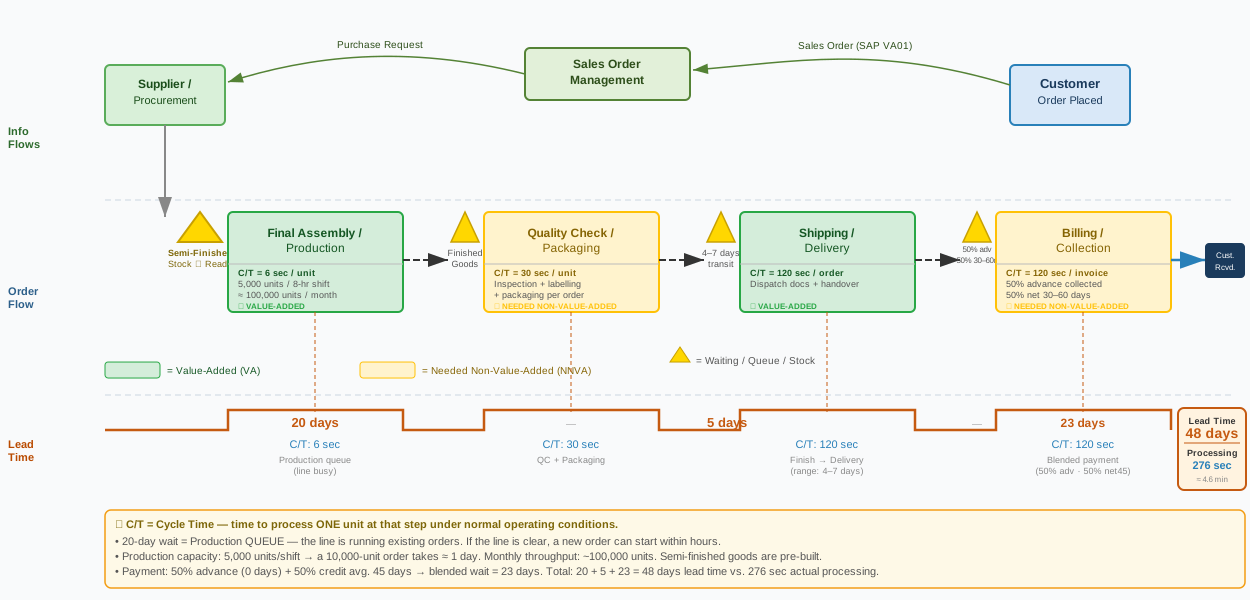
4. How to Read This Map
The map has three horizontal layers.
Layer 1 — Information Flows (Top, Green Arrows)
| Signal | Direction | Meaning |
|---|---|---|
| Sales Order | Customer → Sales Order Management | Triggers the entire O2C process (SAP Transaction: VA01) |
| Purchase Request | Sales Order Mgmt → Supplier / Procurement | Triggers material replenishment or production planning |
Layer 2 — Execution Flows (Middle, Colour-Coded Boxes)
| Process Box | Colour | Classification | What Happens |
|---|---|---|---|
| Final Assembly / Production | 🟢 Green | VA — Value-Added | Semi-finished goods are assembled into finished product |
| Quality Check / Packaging | 🟡 Yellow | NNVA — Needed | Product inspected, labelled, and packed |
| Shipping / Delivery | 🟢 Green | VA — Value-Added | Correct product delivered to the customer |
| Billing / Collection | 🟡 Yellow | NNVA — Needed | Invoice raised; payment collected |
Yellow triangles (▲) between boxes represent waiting inventory or documents sitting idle between steps.
Layer 3 — Lead Time Ladder (Bottom, Orange Zigzag)
| Segment | Wait (Days) | C/T per Unit | What This Means |
|---|---|---|---|
| Order placed → Production starts | 20 days | — | Queue time: line is busy running existing orders |
| Final Assembly | — | 6 sec | Time to assemble one unit on the production line |
| Production done → Delivery | 5 days | 30 sec | QC + packaging + transit time (range: 4–7 days) |
| Delivery → Payment received | 23 days | 120 sec | Blended collection wait (50% advance, 50% net 30–60) |
5. Lead Time Calculation — Step by Step
📌 C/T = Cycle Time — the time to process one unit at a specific step under normal operating conditions. It measures machine or labour time per unit, not waiting time.
A — Production Capacity
| Metric | Calculation | Result |
|---|---|---|
| Shift duration | 8 hours × 60 × 60 | 28,800 seconds |
| Units per shift | Given | 5,000 units |
| C/T per unit | 28,800 ÷ 5,000 | 6 seconds / unit |
| Monthly capacity | 5,000 × 20 shifts | ~100,000 units |
| Batch time (10,000-unit order) | 10,000 ÷ 5,000 | ≈ 1 day of production |
Semi-finished goods are pre-built before the sales order arrives. If the production line is free, a new order can start and be completed within the same day or next day.
B — The 20-Day Production Queue
The 20-day wait before production is not a speed or capacity problem. The line is fast. The wait is caused by the queue of orders already running.
| # | Root Cause | What It Means | Classification |
|---|---|---|---|
| 1 | Running orders on the line | New order must wait for current batches to complete | 🔴 NVA — Queue Waste |
| 2 | Large batch scheduling | Orders are grouped into large runs before switching | 🔴 NVA — Batch Waste |
| 3 | Scheduling slot confirmation | Confirming exact start date in production plan | 🟡 NNVA — Necessary |
If the line is clear → same day start. If the line has 3 large orders queued → 15–20 days wait. The 20-day figure is the average across all orders in the backlog.
C — Payment Collection Calculation
| Payment Type | Share | Days to Collect | Contribution to Lead Time |
|---|---|---|---|
| Advance payment (pre-paid) | 50% | 0 days | 50% × 0 = 0 days |
| Credit payment (net 30–60) | 50% | 45 days avg | 50% × 45 = 22.5 days |
| Blended collection wait | 100% | — | ≈ 23 days |
D — Total Lead Time Summary
| Step | Days | Processing Time | Notes |
|---|---|---|---|
| Production queue wait | 20 days | — | Orders queued on line |
| Final Assembly (C/T) | — | 6 sec / unit | Fast — not the bottleneck |
| Quality Check (C/T) | — | 30 sec / unit | Inspection + packaging |
| Delivery transit | 5 days | 120 sec / order | Dispatch + handover |
| Billing / Collection | 23 days | 120 sec / invoice | Blended payment wait |
| Total Lead Time | 48 days | — | 20 + 5 + 23 |
| Total Processing Time | — | 276 sec ≈ 4.6 min | 6 + 30 + 120 + 120 |
| Value-Added Ratio | — | ≈ 0.02% | 4.6 min ÷ (48 days × 480 min) |
Key Insight: The order exists for 48 days but is actively processed for less than 5 minutes. The remaining 99.98% is queue time, transit, and payment waiting. The production line is not the problem — the scheduling queue before it is.
6. Where the Time Goes — VA vs NNVA vs NVA
O2C Lead Time Distribution — Based on 48-Day Scenario
Example KPI View — Demo Data
DEBUG data: "[\n{ \"category\": \"Value-Added (VA)\", \"percentage\": 1 },\n{ \"category\": \"Needed Non-Value-Added (NNVA)\", \"percentage\": 23 },\n{ \"category\": \"Production Queue / NVA Waste\", \"percentage\": 76 }\n]"
DEBUG parsedData: [
  {
    "category": "Value-Added (VA)",
    "percentage": 1
  },
  {
    "category": "Needed Non-Value-Added (NNVA)",
    "percentage": 23
  },
  {
    "category": "Production Queue / NVA Waste",
    "percentage": 76
  }
]
How each bar is calculated:
| Bar | What it covers | Estimated Time | % of 48 Days |
|---|---|---|---|
| 🟢 Value-Added | Final Assembly (6 sec) + Shipping handover (120 sec) | ≈ 2.1 min | ~1% |
| 🟡 Needed Non-Value-Added | QC (30 sec) + Billing (120 sec) + some scheduling | ≈ 16 hours | ~23% |
| 🔴 Queue / Waste | 20-day production queue + transit + credit collection | ≈ 43 days | ~76% |
The chart and the map tell the same story. Three-quarters of time is the order waiting in queue, in transit, or waiting for payment — none of which adds value for the customer.
7. Biggest Improvement Opportunities
| If you improve... | By doing... | Time saved |
|---|---|---|
| Production queue (20 days) | Smaller batch sizes, better SAP PP capacity planning, order prioritization | Up to 15 days |
| Delivery transit (5 days) | Closer logistics partnerships, better dispatch scheduling | 1–2 days |
| Credit collection (23 days blended) | Increase advance payment %, tighter credit terms | 5–10 days |
| QC process | Inline quality checks during assembly (not after) | Hours |
8. Connecting to the ERP Fit-Gap
To see how this conceptual value stream is mapped into our actual SAP system:
9. Knowledge Check Exercise
Review the O2C Value Stream Map above and answer:
- The production line can produce 5,000 units per shift. Why does a new order still wait 20 days before production starts?
- If the production queue was reduced from 20 days to 5 days, what would the new total lead time be?
- A customer pays 100% in advance. How does this change the total lead time calculation?
- Why is Billing classified as NNVA rather than VA?
- Name two actions that would reduce the 76% waste bar in the chart above.
10. Where Ameco Stands — World Manufacturing Benchmarks
The VSM above shows Ameco's current Order-to-Cash reality. The table below puts those numbers in context against world-class references so learners can clearly see where strengths exist and where improvement potential is greatest.
| KPI | Toyota / World-Class Lean | Typical MTO Manufacturer | Ameco (Current) | Gap / Status |
|---|---|---|---|---|
| Order-to-Delivery days | 1–5 days | 10–20 days | 25 days | Reduce queue from 20 → 5 days |
| Production queue wait | < 1 day | 5–10 days | 20 days | 🔴 Biggest single opportunity |
| C/T per unit (assembly) | 1–10 sec | 5–30 sec | 6 sec | ✅ World-competitive |
| Monthly throughput | Varies | 20,000–50,000 | 100,000 units | ✅ High capacity |
| Delivery transit | 1–3 days (local) | 3–7 days | 5 days | 🟡 Reasonable |
| Invoice-to-cash (blended) | 10–15 days | 20–30 days | 23 days | 🟡 Close to benchmark |
| Total O2C lead time | 15–25 days | 30–50 days | 48 days | ~20 days reducible |
| Value-Added Ratio (O2C) | 0.1–2% | 0.01–0.5% | ~0.02% | Normal for MTO + credit terms |
Key Takeaway: Ameco's production speed (C/T = 6 sec) and monthly capacity (100,000 units) are world-competitive. The gap is entirely in the 20-day production queue — a scheduling and batch-size problem, not a machine or labour problem. Closing this gap alone would bring order-to-delivery from 25 days to around 10 days, placing Ameco in the top tier for Make-to-Order manufacturers.